


Core Executive Summary
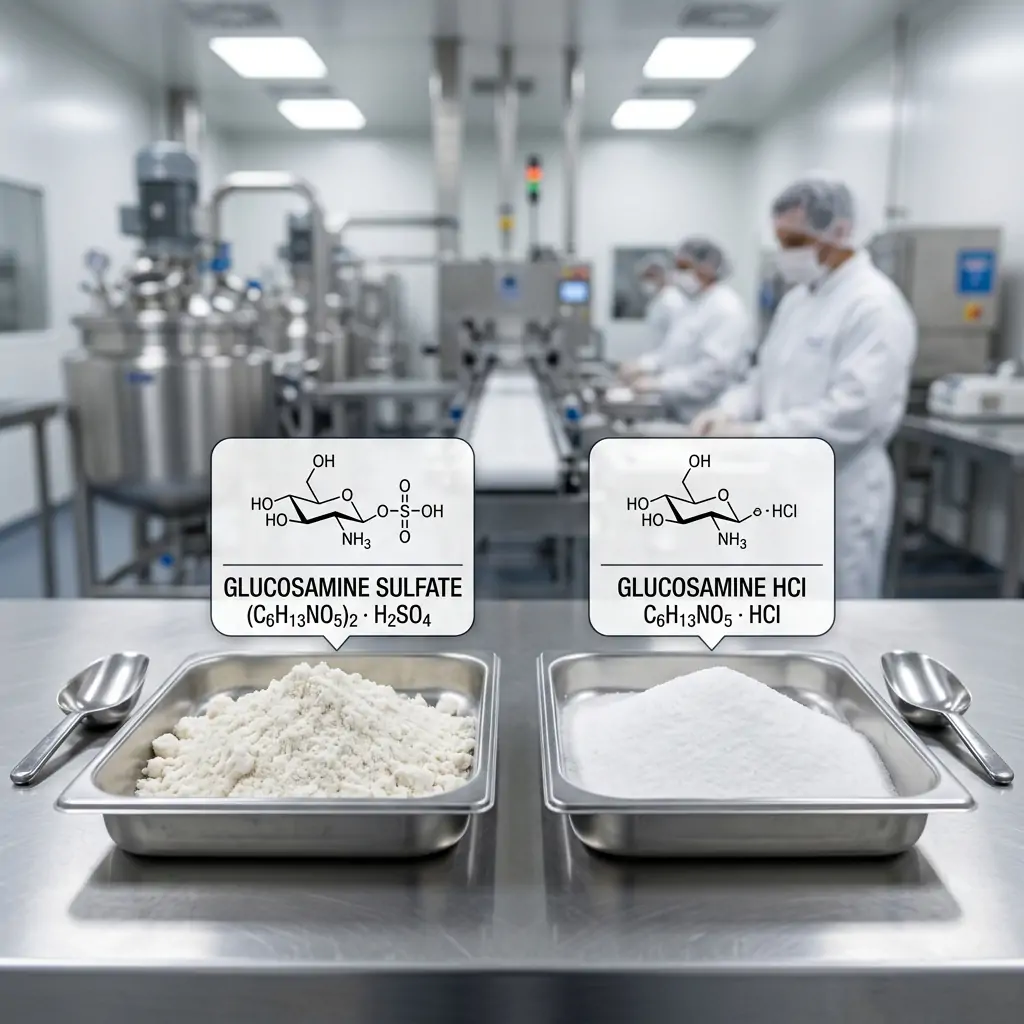
Glucosamine HCl vs glucosamine sulfate is not a bioequivalence debate for formulators, it is a salt-form trade-off between base loading, moisture sensitivity, and inorganic load. Glucosamine HCl assays at 98.0% to 102.0% on the dried basis by HPLC under the USP dietary supplement monograph and delivers 83.1% glucosamine base, while glucosamine sulfate 2KCl assays at the same 98.0% to 102.0% range but delivers only 59.2% glucosamine base because of its co-crystallized potassium chloride. That difference changes tablet size, dose conversion, sodium and potassium declaration, and long-term stability in every format.
For tablet formulations requiring high glucosamine base loading and low moisture sensitivity, glucosamine HCl at 98.0% to 102.0% assay by HPLC is the more stable default. For legacy sulfate-positioned products, glucosamine sulfate 2KCl remains viable when moisture is controlled to a Karl Fischer water content of NMT 1.0%, packaging uses desiccant and moisture-barrier foil, and stability is verified at 40°C and 75% relative humidity for 6 months per ICH Q1A. Selection should follow the finished-product specification, not the historical preference for one salt.
Comparative Physicochemical Profiles
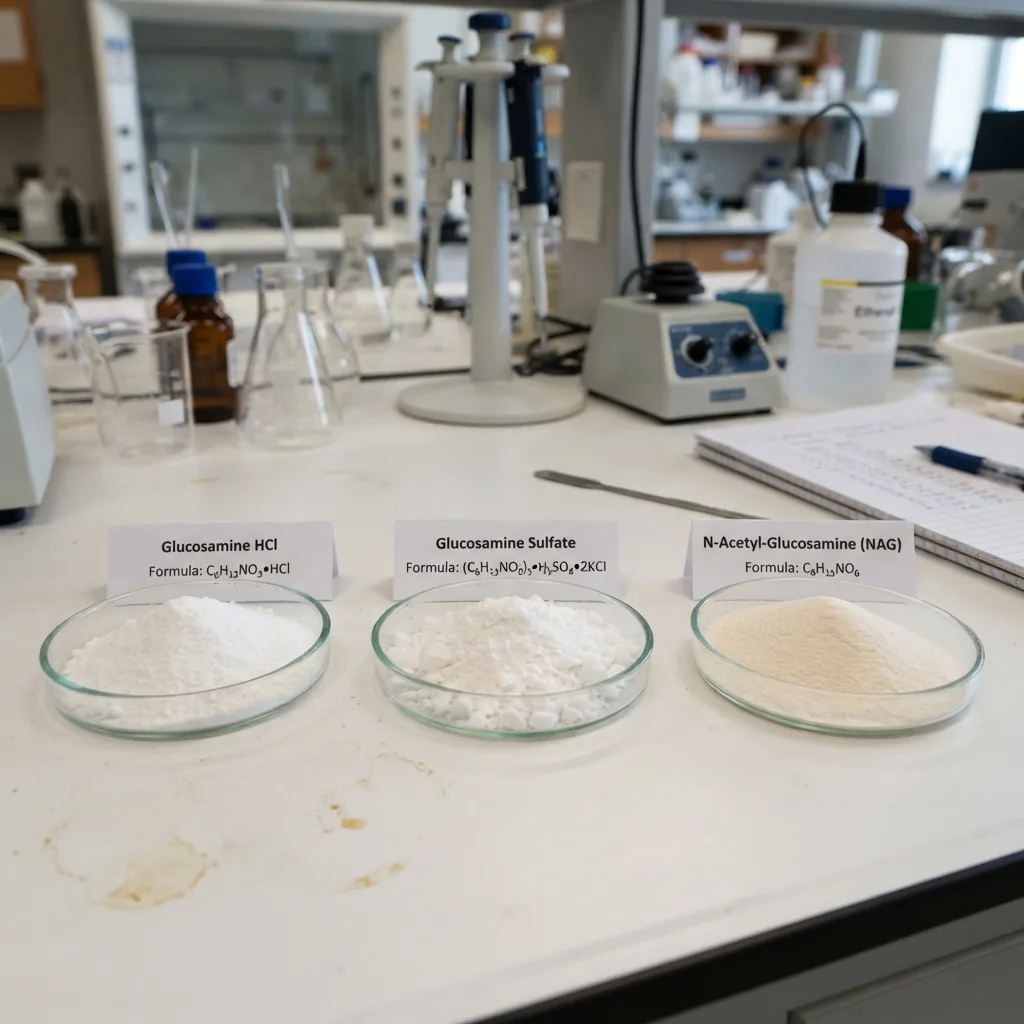
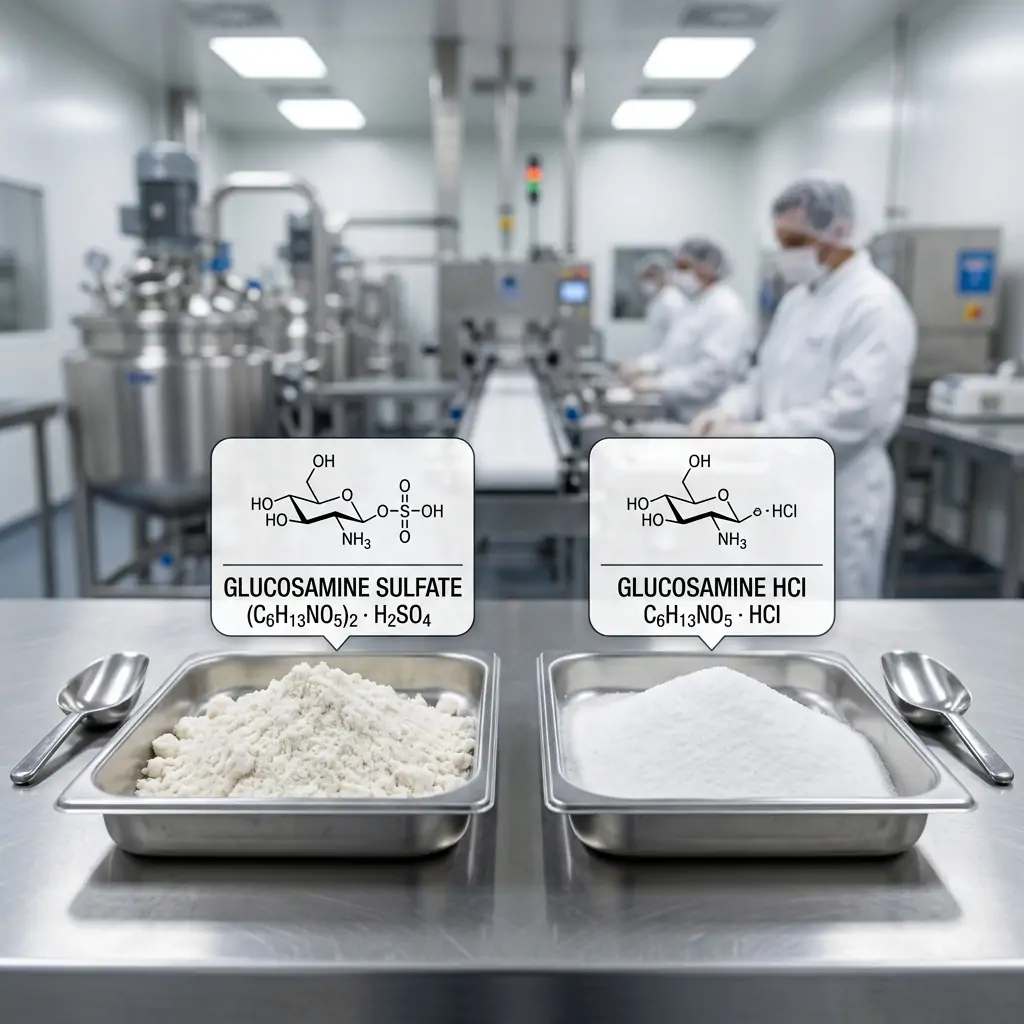
Both salts deliver the same glucosamine molecule, C6H13NO5 with a base molecular weight of 179.17, but they differ in counter-ion, molecular weight, and crystalline stability. Glucosamine HCl, CAS 66-84-2, has the formula C6H13NO5·HCl and a molecular weight of 215.63, while glucosamine sulfate 2KCl, CAS 31284-96-5, has the formula (C6H14NO5)2SO4·2KCl and a molecular weight of 605.52. Both forms are freely soluble in water and are tested for identity by HPLC retention time and infrared spectroscopy under USP Chapter 197, yet only the HCl salt is inherently stable as a single-molecule salt without a stabilizing co-crystal.
Molecular Identity and Glucosamine Base Loading
Dose conversion must use glucosamine base, not salt weight, because label claims and clinical reference doses are expressed as glucosamine. A 1,500 mg dose of glucosamine HCl provides approximately 1,247 mg of glucosamine base, while 1,500 mg of glucosamine sulfate 2KCl provides approximately 888 mg of glucosamine base. To deliver 1,500 mg of glucosamine base, a formula requires 1,805 mg of HCl salt versus 2,534 mg of sulfate 2KCl salt, a difference of 729 mg per dose that directly affects tablet weight, capsule count, and cost-per-dose calculation.
Pure glucosamine sulfate is hygroscopic and chemically unstable in air, so commercial sulfate is stabilized as a double salt with potassium chloride or sodium chloride. Glucosamine sulfate 2KCl contains approximately 12.9% potassium by weight, while glucosamine sulfate 2NaCl, formula (C6H14NO5)2SO4·2NaCl with a molecular weight of 573.31, contains approximately 8.0% sodium by weight. That inorganic load must be declared on nutrition and supplement facts panels and reviewed for sodium-restricted or potassium-restricted formulations under target-market labeling rules.
Solubility, Hygroscopicity, and Degradation Pathways
Both salts show high aqueous solubility, with glucosamine HCl typically described as freely soluble in water at greater than 100 mg per mL at 25°C, and sulfate 2KCl showing comparable solubility for powder and liquid processing. The critical difference is moisture sorption, where unstabilized sulfate absorbs water rapidly and discolors from white to brown, while HCl shows minimal moisture uptake under controlled warehouse conditions at 25°C and 60% relative humidity. Published crystallographic analysis confirms that the sulfate form is hindered by strong hygroscopicity, while the chloride form remains stable as a solid for pharmaceutical processing.
Degradation proceeds through hydrolysis, oxidation, and Maillard-type browning when glucosamine is exposed to moisture, heat, and reducing sugars or reactive amines. Accelerated testing at 40°C and 75% relative humidity for 6 months, with assay by HPLC Chapter 621 and water by Karl Fischer titration Chapter 921, is the minimum screen for color change, assay loss below 98.0%, and increase in loss on drying above 1.0%. Formulations that combine glucosamine with alkaline excipients, high-moisture gummy bases, or open powder handling show the fastest assay drift and require tighter in-process moisture control.
Side-by-Side Technical Specification Table
The table below summarizes USP dietary supplement monograph limits and standard industry COA parameters for qualified material. All assay values are reported on the dried basis, and identity, assay, and related substances must be verified by HPLC Chapter 621 against a USP Reference Standard. Heavy metals are verified by ICP-MS under USP Chapter 233, and microbial limits follow USP Chapters 2021, 2022, and 2023.
| Parameter | Glucosamine HCl | Glucosamine Sulfate 2KCl |
|---|---|---|
| CAS Number | 66-84-2 | 31284-96-5 |
| Molecular Formula | C6H13NO5·HCl | (C6H14NO5)2SO4·2KCl |
| Molecular Weight | 215.63 | 605.52 |
| Assay by HPLC, Dried Basis | 98.0% to 102.0% | 98.0% to 102.0% |
| Glucosamine Base Content | 83.1% | 59.2% |
| Appearance | White to off-white crystalline powder | White to off-white crystalline powder |
| Specific Rotation | +70.0° to +73.0° | Verified against USP Reference Standard |
| Loss on Drying, 105°C for 2 Hours | NMT 1.0% | NMT 1.0% |
| Sulfate / Chloride Content | Chloride 16.0% to 17.0% by titration | Sulfate 15.5% to 16.5%, Chloride 11.1% to 12.8% |
| pH, 10% Aqueous Solution, USP Chapter 791 | 3.0 to 5.0 | 3.0 to 5.0 |
| Heavy Metals / Elemental Impurities by ICP-MS | Lead NMT 0.5 ppm, Total Heavy Metals NMT 10 ppm | Lead NMT 0.5 ppm, Total Heavy Metals NMT 10 ppm |
| Microbial Limits | TAMC NMT 1,000 CFU per g, TYMC NMT 100 CFU per g, E. coli and Salmonella absent in 10 g | TAMC NMT 1,000 CFU per g, TYMC NMT 100 CFU per g, E. coli and Salmonella absent in 10 g |
| Residual Solvents, USP Chapter 467 | Methanol NMT 3,000 ppm, Ethanol NMT 5,000 ppm | Methanol NMT 3,000 ppm, Ethanol NMT 5,000 ppm |
| Storage | Tight, moisture-proof container at 15°C to 25°C, protected from light | Tight, moisture-proof container at 15°C to 25°C, protected from light and humidity |
Assay must be interpreted on the dried basis, not as-is, because a 1.0% difference in water content can shift a borderline 98.0% result below specification after storage. A compliant COA must state the method as HPLC Chapter 621, the reference standard lot, the drying condition at 105°C for 2 hours, and the calculation basis for sulfate and chloride content. Any COA that reports only a single assay number without loss on drying, specific rotation, and elemental impurity data is insufficient for QA release under GMP.
Formulation and Stability: Processing Decisions That Determine Shelf Life
Formulation stability for glucosamine is governed by water activity, processing temperature, and contact time with moisture, not by the salt name on the label. Both salts require in-process relative humidity control below 40% RH during dispensing and granulation, with granulation moisture held below 2.0% by Karl Fischer titration before compression or encapsulation. Finished-product testing should include assay by HPLC, water content, color, and dissolution at release and at 3, 6, 12, and 24 months under ICH long-term conditions.
Tablet and Capsule Formulation
Glucosamine HCl is preferred for high-dose tablets because 1,805 mg of HCl salt delivers 1,500 mg of glucosamine base, while the same base dose requires 2,534 mg of sulfate 2KCl and often forces a two-tablet serving. Direct compression is feasible with microcrystalline cellulose and silicon dioxide as diluent and glidant, with magnesium stearate limited to 0.5% to 1.0% to avoid hydrophobic coating and dissolution delay. Tablet friability must meet USP Chapter 1216 at NMT 1.0% weight loss, and dissolution by USP Chapter 711 should target NLT 75% dissolved in 30 minutes in water at 37°C for immediate-release tablets.
Capsule filling requires control of powder flow and static, with bulk density and tapped density measured to calculate Carr index and Hausner ratio before scale-up. For sulfate 2KCl capsules, desiccant in HDPE bottles and induction-sealed closures are required because the salt gains moisture faster than HCl at 40°C and 75% relative humidity. Stability failures in sulfate capsules most often appear as hardening, discoloration, and assay loss, not as microbial failure, and they are detected first by water content above 1.0% and color shift.
Powder, Liquid, and Gummy Formats
Powder stick packs and tubs require the lowest water activity and the strongest moisture barrier, with water activity below 0.60 and foil laminate packaging verified by seal-integrity testing. Glucosamine HCl is the lower-risk choice for powders because its lower hygroscopicity reduces caking, while sulfate 2KCl powders require anti-caking silicon dioxide and nitrogen flushing to maintain flow after 12 months. Liquid suspensions and ready-to-drink formats require pH control at 3.0 to 5.0 by USP Chapter 791, preservative efficacy testing, and assay verification after heat processing at 70°C to 85°C.
Gummies present the highest stability risk because the gelatin or pectin base retains 12% to 18% moisture and is processed at 80°C to 95°C, which accelerates Maillard browning and glucosamine degradation. Water activity must be held at NMT 0.65, drying time must be validated, and glucosamine assay should be tested after gummy curing, not only after mixing, because loss during curing can exceed 3.0%. For gummies, HCl is often selected for its higher base loading and cleaner solubility, while sulfate requires tighter temperature control and a shorter validated shelf life.
Excipient Compatibility and Moisture Control
Compatibility screening should test glucosamine against each excipient at 40°C and 75% relative humidity for 4 weeks, with assay by HPLC and color assessment at each time point. Chondroitin sulfate, methylsulfonylmethane, and vitamin C are compatible in dry blends, but chondroitin sulfate is itself highly hygroscopic and can increase blend moisture above 2.0% if stored without desiccant. When combined with chondroitin sulfate or MSM in joint health raw materials, the blend must be specified as a low-moisture system with water content tested by Karl Fischer titration and packaging validated for moisture vapor transmission rate.
Packaging is a formulation variable, not an afterthought, because moisture ingress drives most glucosamine assay failures. HDPE bottles with 1 g to 2 g silica gel desiccant, aluminum-aluminum blisters, and foil stick packs reduce moisture uptake to below 1.0% water over 24 months at 25°C and 60% relative humidity. Bulk raw material should be stored in double polyethylene bags inside sealed drums at 15°C to 25°C, with retest after opening and a maximum open-container hold time defined in the batch record.
Application-Specific Recommendation Matrix
The matrix below translates base loading and stability into format decisions. Dose values are expressed as glucosamine base, with salt weight calculated from the 83.1% factor for HCl and the 59.2% factor for sulfate 2KCl. All recommendations assume assay at 98.0% to 102.0% by HPLC and water content at NMT 1.0% on release.
| Application | Preferred Salt | Technical Rationale |
|---|---|---|
| High-dose single tablet, 1,500 mg base | Glucosamine HCl | 1,805 mg salt fits one tablet, lower moisture sensitivity, friability NMT 1.0% |
| Two-tablet sulfate legacy formula | Glucosamine Sulfate 2KCl | 2,534 mg salt split across two tablets, requires desiccant and foil barrier |
| Hard capsule, 500 mg to 750 mg base | Glucosamine HCl | Higher base per capsule, simpler flow, water NMT 1.0% at fill |
| Powder stick pack or tub | Glucosamine HCl | Lower caking risk, water activity below 0.60, foil laminate required |
| Liquid or suspension | Glucosamine HCl | High solubility above 100 mg per mL, pH 3.0 to 5.0, validated heat stability |
| Gummy, 250 mg to 500 mg base per serving | Glucosamine HCl | Higher loading in limited gummy mass, water activity NMT 0.65 after curing |
| Low-sodium or low-potassium claim | Glucosamine HCl | No potassium chloride or sodium chloride stabilizer, no added 8.0% to 12.9% inorganic salt |
For a new formulation with no legacy sulfate claim, HCl provides the simplest path to a stable, high-dose, single-tablet product with assay held at 98.0% to 102.0% through 24 months. For an existing sulfate product, switching salts requires reformulation, new dissolution and stability data, and label revision for glucosamine base, potassium, and sodium content. The matrix should be validated with three pilot batches and ICH stability data before commercial scale-up.
Sourcing, Quality Control, and Regulatory Compliance Evaluation
When qualifying a supplier of functional raw materials, QA should require a full COA with assay by HPLC Chapter 621, identity by infrared spectroscopy, loss on drying at 105°C for 2 hours, specific rotation, sulfate and chloride content by titration, elemental impurities by ICP-MS Chapter 233, residual solvents by GC Chapter 467, and microbial limits by USP Chapters 2021 to 2023. Batch-to-batch assay variation should be controlled to a relative standard deviation of NMT 2.0% across three consecutive lots, with water content held at NMT 1.0% on each lot. Any lot that reports assay without method, reference standard, and drying basis should be placed on QA hold.
Source verification is essential because glucosamine is produced from shellfish chitin or by fermentation from corn or Aspergillus niger, and the source determines allergen labeling, vegan status, and Halal and Kosher compliance. Shellfish-derived material requires crustacean allergen declaration under US FDA and EU Regulation 1169/2011, while fermentation-derived material must document the organism, substrate, and absence of shellfish protein by ELISA below the limit of detection. Suppliers should provide ISO9001, ISO22000, GMP, and, where claimed, NSF, Halal, and Kosher certificates with audit dates and scope.
Regulatory status depends on market, with glucosamine sold as a dietary supplement under DSHEA in the United States, as a food supplement in the EU, and as a drug or supplement in other jurisdictions with distinct daily-dose and claim rules. The USP dietary supplement monographs for glucosamine HCl, glucosamine sulfate potassium chloride, and glucosamine sulfate sodium chloride provide the assay and impurity framework for US release, while EP monographs apply for European release. QA must confirm that the COA standard cited matches the destination market, because USP and EP limits for loss on drying, specific rotation, and impurities are not interchangeable.
Frequently Asked Questions
Can glucosamine HCl and glucosamine sulfate 2KCl be used interchangeably at the same weight?
No, 1,500 mg of HCl provides 1,247 mg of glucosamine base, while 1,500 mg of sulfate 2KCl provides 888 mg of base, so dose must be recalculated by the 83.1% and 59.2% factors.
Which salt is more stable for long-term storage?
Glucosamine HCl is more stable as a single salt, while sulfate 2KCl requires moisture-barrier packaging and desiccant to hold water at NMT 1.0% and assay at 98.0% to 102.0% through 24 months.
What COA tests are mandatory for QA release?
QA release requires assay by HPLC Chapter 621, identity by infrared spectroscopy, loss on drying at 105°C for 2 hours, elemental impurities by ICP-MS Chapter 233, and microbial limits per USP Chapters 2021 to 2023.
Does glucosamine sulfate 2KCl add potassium or sodium to the label?
Yes, sulfate 2KCl adds approximately 12.9% potassium by weight, while sulfate 2NaCl adds approximately 8.0% sodium, and both must be reflected in supplement facts and sodium or potassium declarations.
Can glucosamine be used in gummies without assay loss?
Yes, when water activity is held at NMT 0.65, processing temperature is controlled below 95°C, and assay is verified by HPLC after curing, not only after mixing, For more details, please visit our glucosamine knowledge hub page..
About the Publisher: This technical briefing is published by Gothink Biology, a global manufacturer and biomanufacturing supplier of functional raw materials based in Shenzhen, China. Operating a 100,000-class GMP-certified production facility with a daily capacity of 16 tons, Gothink Biology specializes in high-purity coenzymes, HMOs, glucosamine derivatives, and functional sweetening compounds. Our R&D team, led by scientists with postdoctoral backgrounds from Cold Spring Harbor Laboratory and Emory University, develops 2,000+ custom formulations annually under ISO9001, ISO22000, GMP, NSF, SGS, Halal, and Kosher certifications.